Objects of Desire
Rooms that listen: Carnegie Hall, the Vanguard and an organ with rooms of its own
A hall Tchaikovsky opened, a basement of 2,700 Mondays and an organ that needs eleven rooms.

Photo Credit
Image courtesy of © Ajay Suresh from New York, NY, USA · CC BY 2.0 via Wikimedia CommonsWhat makes a room sound right? New York has tested the question at every scale, from a concert hall designed by a cellist who had never built one to a 130-seat basement on Seventh Avenue South and a music hall whose organ needs eleven rooms. Here are the rooms worth hearing and the stories behind them, checked against the venues’ own pages in November 2026.
A cellist’s concert hall
Carnegie Hall opened on 5 May 1891 with a five-day festival, and the opening concert marked the American debut of Pyotr Ilyich Tchaikovsky, who conducted his own Marche Solennelle. He performed three more times that week, which is a fair way for any building to be introduced. The programme opened with the hymn “Old Hundredth” and a lengthy dedication speech from Bishop Henry Codman Potter, so the slow first half is as old as the hall.
The architect, William B. Tuthill, was a professional architect and a cellist who had never built a concert hall before; the Chicago firm of Adler and Sullivan and Richard Morris Hunt served as consultants. The result on West 57th Street still presents classical, jazz, folk, world and pop, with the Russian Tea Room next door for supper afterwards.
A basement in the Village
The Village Vanguard has been at 178 Seventh Avenue South since 1935, down a stair into a 130-seat room whose wedge shape is often credited for its sound. Max Gordon founded it; his widow, Lorraine, ran it from 1989, and their daughter Deborah has run it since 2018. It is a room where the walls have heard more good music than most record collections.
This year the club told its own story in Last of the Jazz Joints, a history by Deborah Gordon with Jed Eisenman and Eric Allen that recalls the early Vanguard of poets, comedians and folk singers. A few blocks east, the Blue Note has hosted jazz at 131 West 3rd Street since 1981.
In February 1966 Gordon booked a new big band, the Thad Jones/Mel Lewis Orchestra, for three Monday nights. “We’ll keep it going until it tapers off,” he told Mel Lewis. More than 2,700 Mondays later, the club notes, it still hasn’t: the band, now the Vanguard Jazz Orchestra, plays every Monday night.
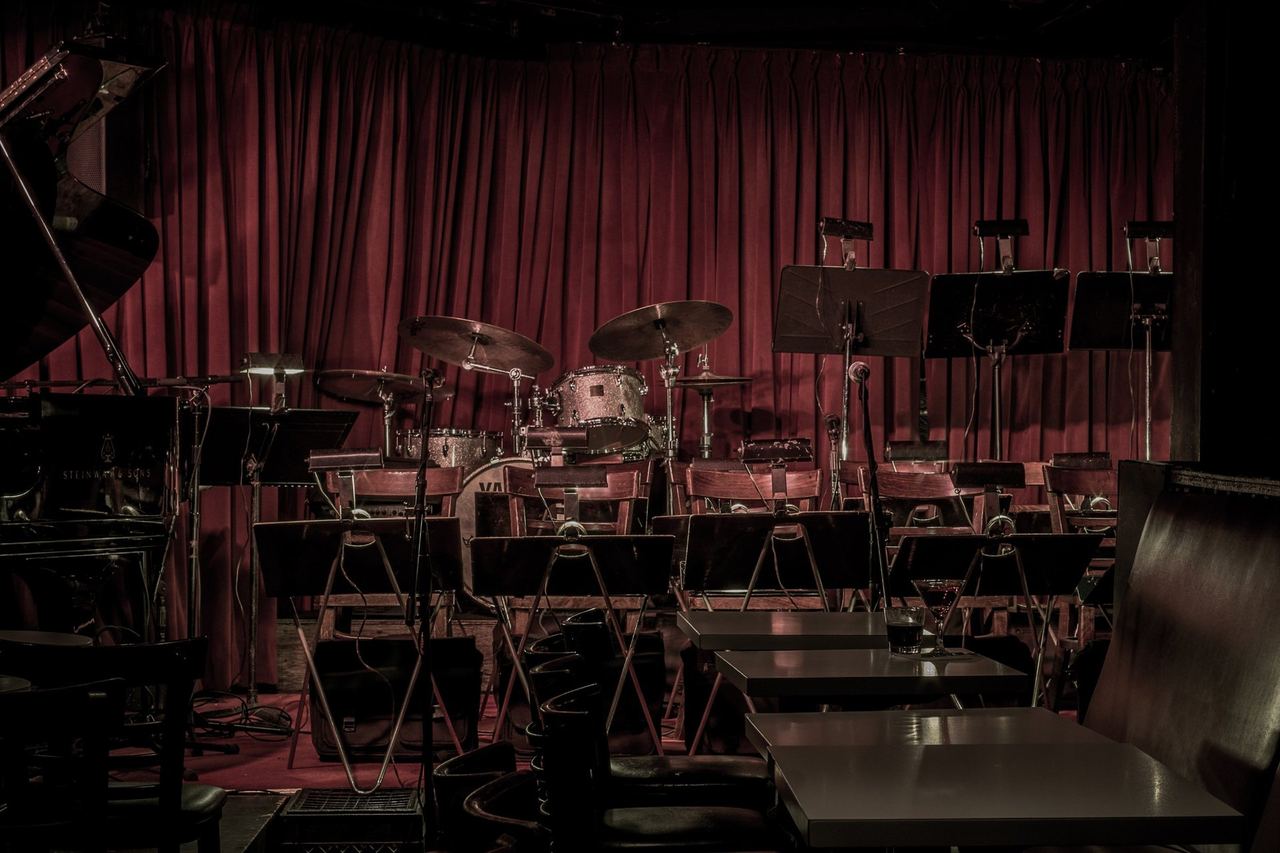
Photo Credit
Image courtesy of © Village VanguardFurther uptown, Birdland takes its name from Charlie Parker and has hosted Dizzy Gillespie and John Coltrane; its West 44th Street room is handy after a Broadway show. Between them, these basements prove that the best acoustics in New York are often found a floor below the pavement.
The organ is less an instrument than a building with opinions.
An organ with its own rooms
Radio City Music Hall opened on 27 December 1932, with interiors by Donald Deskey. It came close to demolition in 1978 and was designated a landmark in 1979, a near miss that now looks like a lucky escape for the whole of Sixth Avenue. Two weeks after opening it premiered its first film, The Bitter Tea of General Yen, and more than 700 films have opened there since.
Its Mighty Wurlitzer was built for the theatre, and its pipes live in eleven separate rooms, from a few inches to 32 feet tall. The organ is less an instrument than a building with opinions, and when it plays, the seats feel it before the ears do.
Glass above Columbus Circle
Jazz at Lincoln Center took the opposite approach to the Vanguard. Its glassy Frederick P. Rose Hall floats five storeys above Columbus Circle, with three venues including the Rose Theater for more than 1,200 people, and at Dizzy’s Club the band plays with the city lights behind the stage, which is hard on anyone trying to watch the drummer.
Our advice: hear one great hall and one small room in the same week. Book Carnegie Hall from its own calendar, take a Monday at the Vanguard for the big band, and arrive early anywhere with a queue on the pavement.

Photo Credit
Image courtesy of © Suicasmo · CC BY-SA 4.0 via Wikimedia CommonsWhy it's on our list
- A cellist’s concert hall
- A basement in the Village
- An organ with its own rooms
- Glass above Columbus Circle
Location
The map comes from Google Maps, which sets its own cookies once it loads.
More in depth
 Objects of DesireThe cube, the @ and the shuttle: New York’s machines under glassApple’s glass cube, the @ sign at MoMA and a space shuttle on a Hudson pier.
 Objects of DesirePencils, twists and a piano hall: New York’s new towersA tower on Steinway Hall, ten-foot windows on Park Avenue and BIG’s twisting pair by the High Line.
 Objects of DesireStirred, never hurried: the Manhattan and the bars that keep itThe IBA’s Manhattan, the St. Regis’s Red Snapper and the city’s most serious cocktail rooms.